Beautiful Red Rose Redwork
A Practical Review for Small Business Merch & Branded Patches
As an embroidery designer who’s digitized and stitched thousands of designs for cafés, boutiques, florists, bakeries, pet brands, and handmade studios, I approach every machine embroidery design with two questions: “Does it tell the brand’s story?” and “Will it hold up in real-world production?” That’s why Beautiful Red Rose Redwork caught my eye—not just as a floral motif, but as a versatile asset for small business merch. Let’s break down how this embroidery file performs beyond aesthetics.
First Impression: Classic, Handmade, and Confidently Simple
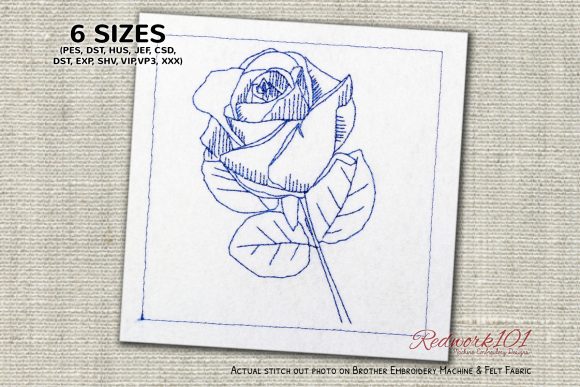
Right away, Beautiful Red Rose Redwork signals warmth and authenticity. The title alone evokes tradition—redwork is rooted in American folk embroidery, known for clean lines, bold outlines, and narrative charm. It reads as elegant yet approachable, neither overly ornate nor too minimal. For a local florist’s apron or a boutique’s tote bag design, that balance is gold: professional enough for customer-facing wear, friendly enough to feel human-made. It leans into the handmade product ethos without sacrificing polish—ideal for brands that want to signal care, craft, and heritage.
Real-World Performance Across Merch Applications
In practice, Beautiful Red Rose Redwork shines where clarity and character matter most:
- Embroidered patch: Works beautifully at 2–3" wide on twill or chenille backing. Its open structure avoids excessive stitch density, reducing puckering risk and stabilizer dependency.
- Apron embroidery and cap embroidery: Sits cleanly on curved surfaces (like cap fronts or apron pockets) thanks to its balanced proportions and minimal interior detail.
- Tote bag design and custom apparel: Reads well at medium scale on canvas, cotton duck, or linen—fabrics common in boutique merchandise. The redwork style inherently handles fabric texture better than tightly filled motifs.
- Product packaging accents and customer gifts: Stitches cleanly onto kraft tags, muslin pouches, or gift box labels when sized appropriately (1–1.5").
- Commercial embroidery projects: Fits seamlessly into a broader suite of design assets—pair it with monogram initials, simple borders, or complementary single-flower motifs from the Single Flowers category for visual consistency.
Because it’s a redwork interpretation—not photorealistic—it avoids common pitfalls like muddy gradients or fragile fine lines. That makes it unusually forgiving across fabric types and stitch counts.
Where to Use Beautiful Red Rose Redwork Thoughtfully
Even strong designs need context-aware deployment. Here’s where extra attention pays off:
- Small patch sizes (<1.25"): Test stitch-out first. While the rose outline holds, inner details may blur—consider simplifying or using a variant optimized for miniaturization.
- Dark uniforms: Red thread on navy or charcoal reads richly—but confirm contrast with your actual thread vendor’s reds. Some “red” shades dull on black fabric.
- Frequent-wash items (e.g., staff aprons): Redwork’s low-fill nature helps longevity, but always use high-quality polyester thread and appropriate stabilizer (cutaway for stretch fabrics, tear-away for stable weaves).
- Curved or textured fabric (denim jackets, corduroy caps): Hoop securely and reduce top tension slightly—Beautiful Red Rose Redwork’s open layout responds well to these adjustments.
- Cap fronts: Avoid placing near the bill seam unless digitized with underlay reinforcement. Its clean shape works best centered above the visor.
How It Strengthens Brand Identity & Customer Trust
For small businesses, every embroidered element is a silent ambassador. Beautiful Red Rose Redwork builds trust by signaling intentionality—not just decoration. A café using it on barista aprons tells customers, “We value craft.” A pet brand stitching it onto bandanas says, “We honor tradition and tenderness.” That emotional resonance lifts perceived product value and supports repeat engagement—especially on Etsy or local markets where buyers choose based on feeling, not just function.
Visually, it anchors brand identity without overwhelming. Unlike busy logos, it leaves breathing room for names, slogans, or other elements—making it ideal for modular branding systems. And because it’s part of the Embroidery category’s Single Flowers family, it scales naturally alongside future assets (e.g., a lavender sprig for seasonal merch or a daisy for summer collections).
Essential Designer Notes Before You Stitch
Before launching Beautiful Red Rose Redwork into production, run these checks:
- Test in black and white first—confirm legibility and balance without color distraction.
- Check small-patch viability: Resize to your target dimensions and simulate stitch density visually.
- Review thread color contrast against your base fabric—especially on dark or heathered textiles.
- Inspect spacing and clearances: Ensure no elements are too tight for your machine’s minimum jump distance.
- Confirm hoop size compatibility—some versions include optional framing (like “The Stitch Box” mentioned in the description), which may affect fit.
- Test on real fabric, not just software preview—fabric texture dramatically impacts redwork’s crispness.
- Use proper stabilizer for your substrate; redwork relies on stability more than fill does.
- Create a printable mockup for client approval—this prevents costly re-runs and builds confidence early.
- Compare beside existing design assets to ensure visual harmony across your branded ecosystem.
- Verify commercial licensing before selling finished products—since the description notes “The Stitch Box shown in the picture is optional,” confirm whether included elements carry usage restrictions.
Remember: Beautiful Red Rose Redwork isn’t just a pretty flower—it’s a strategic tool. When applied intentionally, it elevates custom apparel, deepens connection with local audiences, and reinforces the handmade integrity your small business stands for. Whether stitched on a bakery’s flour-dusted apron or a florist’s reusable tote, it doesn’t shout—it invites. And in today’s crowded marketplace, that quiet confidence is exactly what converts browsers into loyal customers.